


Monitor payments, customer balances, reminders and SEPA direct debits
Objective. Read and manage a customer account from end to end: connect issued invoices, due dates, payments, matching, differences, reminders, SEPA batches, rejected transactions and accounting controls so that every balance can be explained.
Before you start: choose a customer account to analyse
In your subscription, select a customer you may view, with two issued open invoices and an exact or partial payment. Record references, due dates, gross amounts, amounts paid and opening balance before changing screen. Perform any payment entry, movement, matching or reminder only when your role and accounting procedure allow it; otherwise work read-only.
Numerical example for learning the method
Use this as a prepared accounting worksheet: an example company, bank BNK01, payment method Bank transfer, invoice F2026-041 for EUR 1,200.00 including tax, invoice F2026-055 for EUR 600.00 and transfer VIR-041 for EUR 1,185.00. The EUR 15.00 difference is presented as documented bank charges, but its accounting nature and sign must be established before any customer movement is created. Charges borne by your company may belong in a separate bank-expense entry and can leave EUR 15.00 genuinely due. Only if the approved treatment requires a customer movement of EUR -15.00 may the three lines clear F2026-041. F2026-055 then remains open for EUR 600.00. Keep these references on the worksheet and use the actual references selected in your subscription on screen.
Checks before any action
- Use the two issued invoices and the payment selected in your subscription; do not create the fictional ALPHA records.
- Check that the selected customer, bank and payment method are active and that your rights cover payments, movements and matching.
- You know the justification, sign and counter-entry for the EUR 15.00 difference. Never create a miscellaneous movement merely to make a screen reach zero.
- The SEPA part is a review only. Do not transmit a real bank file or send a real reminder outside an authorised test procedure.
60-minute schedule
- 8 min: read the customer account and state the opening diagnosis.
- 12 min: enter and verify the EUR 1,185.00 payment.
- 12 min: perform the first match and observe the EUR 15.00 remainder.
- 12 min: document the approved treatment and complete matching if justified.
- 10 min: verify the balance, reminder population and SEPA data.
- 6 min: assemble the evidence and formulate reusable controls.
Observable checkpoints in the prepared dataset
- Before correction, the proposed group does not clear and the difference is exactly EUR 15.00.
- In the approved training branch, F2026-041, VIR-041 and the EUR -15.00 movement total zero and share a matching reference.
- The total customer balance is EUR 600.00 only when the first invoice has been cleared legitimately; otherwise the EUR 15.00 stays visible and explained.
- The reminder selection excludes F2026-041 only if its real balance is zero and retains F2026-055 for EUR 600.00.
Understand the control chain before clicking
A customer balance is not a single field. It is the result of invoices, credit notes, expected instalments, received payments, miscellaneous movements, rejections and matching. The sales journal proves that an invoice was issued; the payments table proves that money was recorded; customer movements and matching explain which document that money settles. Reading only one of these screens can lead to a false reminder or a false sense that an account is clear.
A full, partial or grouped payment must retain a useful date, company, bank, method, reference, amount and customer. Matching then associates one or more payments with one or more invoices or credit notes. It never replaces the investigation of a difference. A bank charge, discount, write-off, wrong customer, duplicate import or rejected debit each requires a different treatment and approval.
The same discipline applies to SEPA. A mandate, RUM, IBAN, BIC, sequence, due date and creditor bank account describe the expected collection. A generated file is not proof that the bank accepted it, and an expected debit is not an actual payment. Keep expected, submitted, accepted, rejected, recorded and matched states distinct.
Capabilities acquired
- Retrieve payments, customer movements, issued invoices and open balances within one company, customer and period.
- Record or review a payment using traceable banking information, then prevent duplicate manual and imported entry.
- Match exact, partial and grouped payments and explain a residual amount without hiding it.
- Read payment terms and instalments before deciding that an invoice is overdue.
- Review mandate and SEPA preparation data without confusing file generation with bank settlement.
- Prepare a reminder only after checking recent unmatched payments and rejected transactions.
- Reconcile customer follow-up with accounting export and cash-basis VAT where that option applies.
1. Establish the reliable account perimeter
Path: Billing > Payments, then Billing > Customer movements.
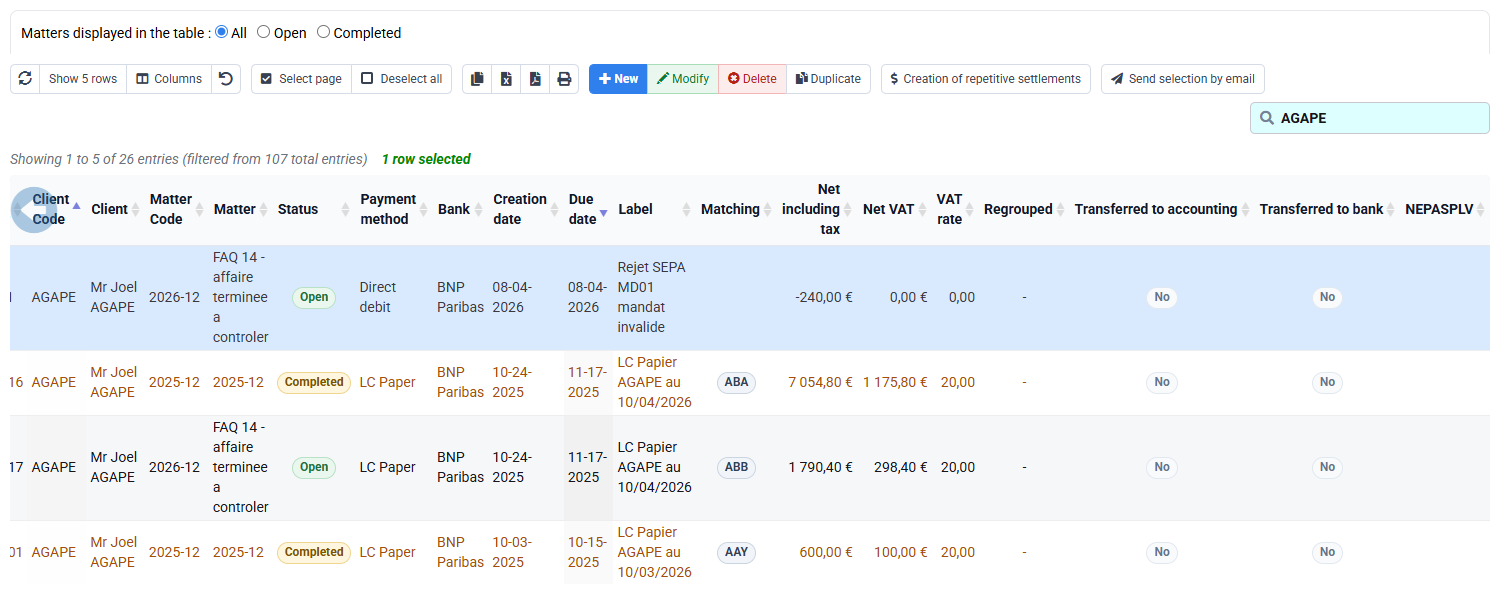
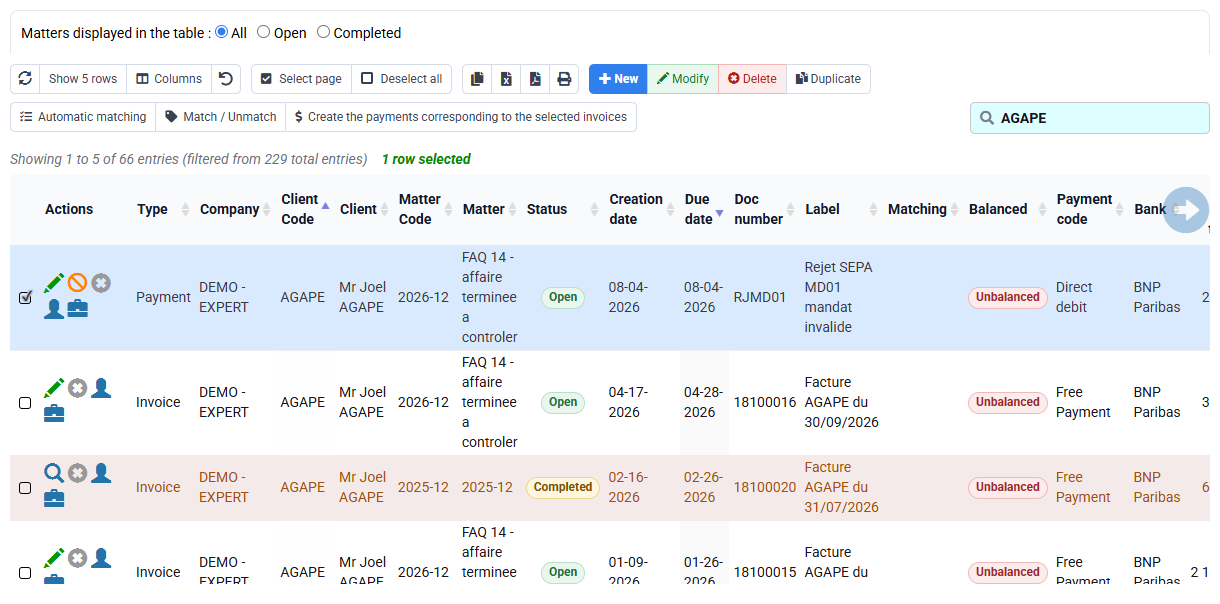
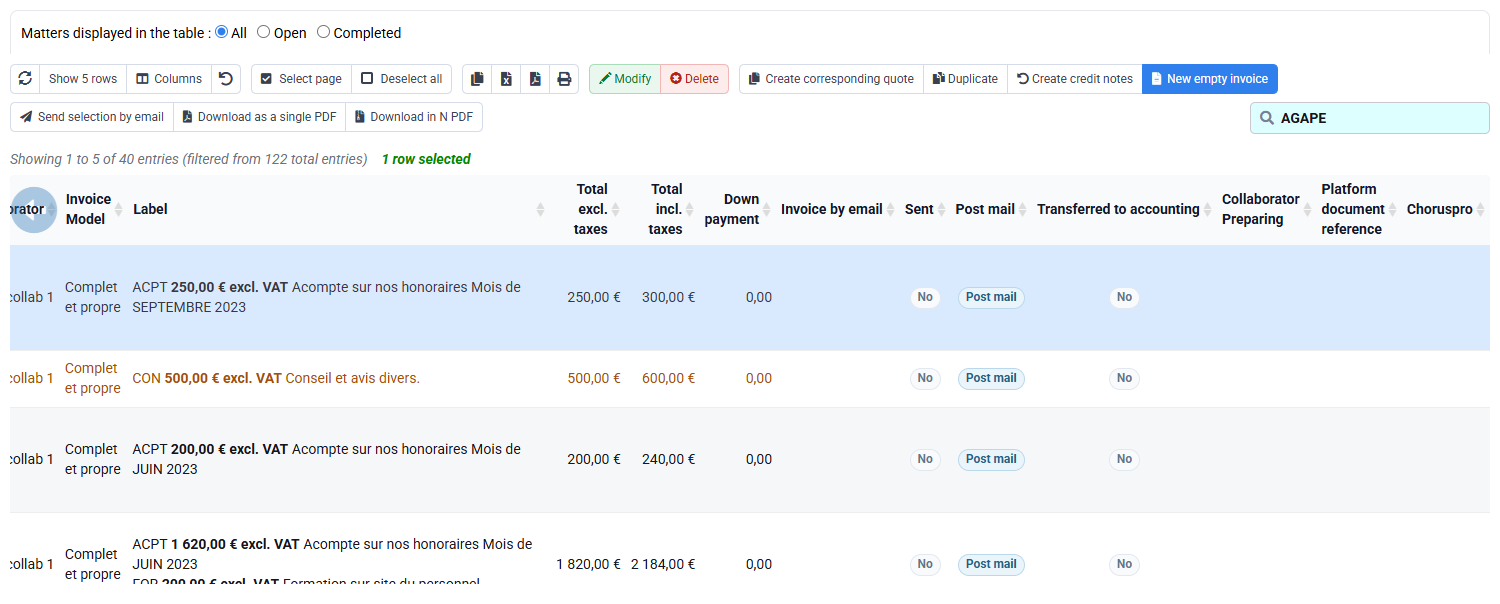
In Tempolia, select the customer, two open issued invoices and exact or partial payment chosen in your subscription, then apply one common period to all three source screens. First write down the expected opening account: EUR 1,800.00 invoiced and EUR 1,185.00 received, therefore EUR 615.00 remains open before the EUR 15.00 decision: EUR 600.00 on F2026-055 and EUR 15.00 on F2026-041. Confirm references, dates, signs and status rather than relying on a total alone. Remove unrelated saved filters and make sure your access rights do not conceal another line.
For the selected customer, the payment list should show the payment and its banking reference, and the movement table should show the invoices and payment being analysed. Filter each screen to your selected customer and inspect reference, date, amount, status, matching and balance. If the screen displays No data, check company, customer, period, filters and access rights before continuing.
2. Verify the payment, then match it
In the authorised database containing the prepared case, open VIR-041 and check customer, company, date, EUR 1,185.00 amount, bank BNK01, Bank transfer method and stable reference. Search that reference before saving any imported or manual line. A duplicate payment can make the overall balance look favourable while corrupting the account and the accounting export.
On the worksheet, calculate the first allocation. Perform the matching in Tempolia only in the authorised database containing the prepared case: select F2026-041 and VIR-041 for the first matching attempt. The difference must be EUR 15.00, not EUR 2,385.00; the latter usually indicates an inverted sign or wrong movement type. Stop and state the cause. If the approved accounting decision is to retain EUR 15.00 due, leave the remainder open. If an authorised EUR -15.00 customer movement is appropriate, document its reason and counter-entry, create it in the test flow, then match all three lines. Never alter the issued invoice or payment to force equality.


3. Check due dates, payment terms and SEPA prerequisites
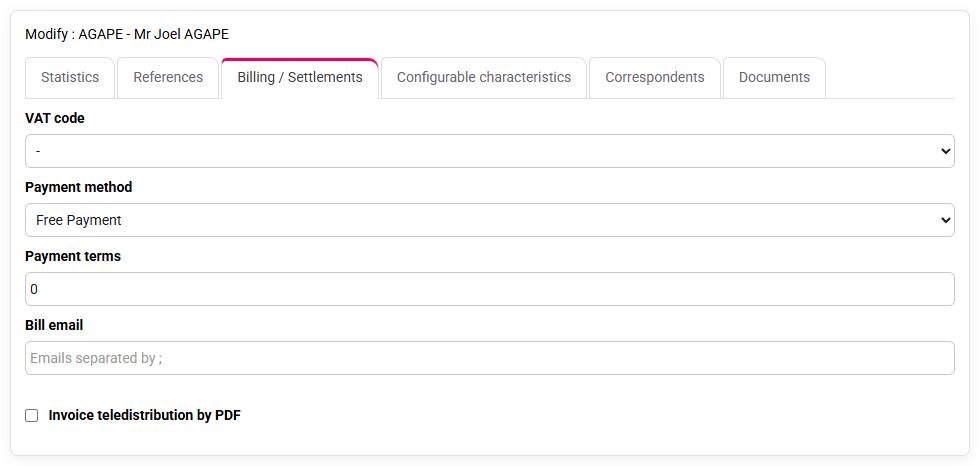
Before calling an item overdue, inspect the invoice date, contractual due date, payment method and any instalment schedule. The customer billing tab supplies default terms, but the issued document and generated instalments are the operational evidence. A prepared invoice is not yet an issued sales-journal item.
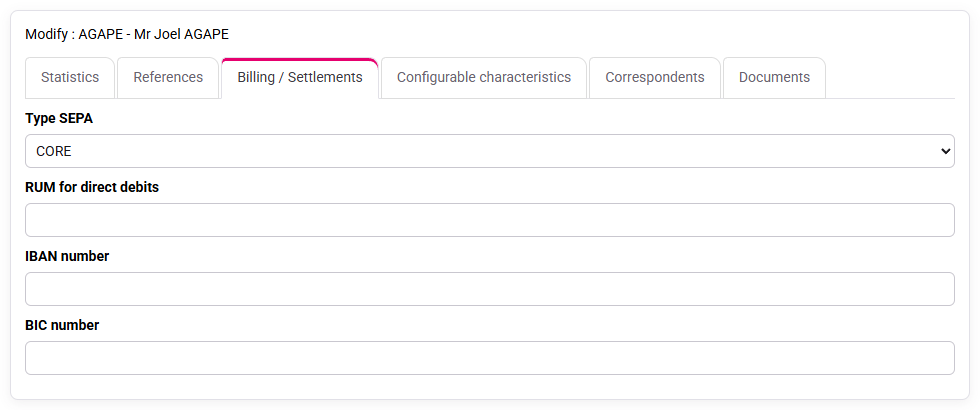
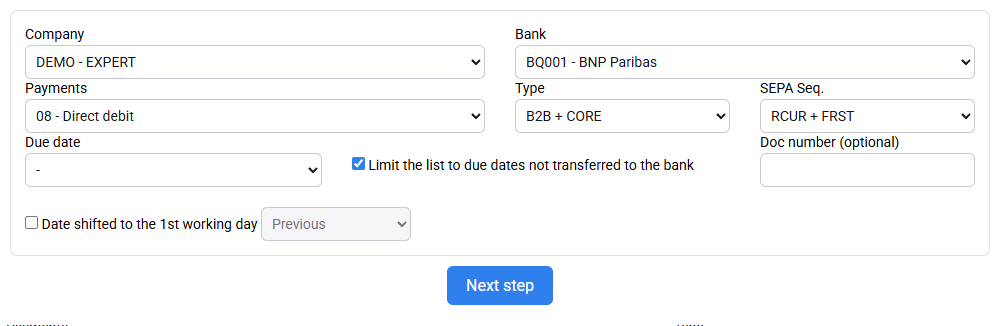
For a SEPA customer, review the signed mandate, unique mandate reference, IBAN, BIC, Core or B2B scheme, sequence and creditor bank account. Inspect the eligible-payment selection before generating anything. The exercise stops before real transmission. A generated XML or bank file would only prove preparation; bank feedback and a recorded payment are separate stages. If a rejection exists, retain its code, date and link to the original collection before deciding whether to represent or contact the customer.
4. Prepare a reliable reminder and reconcile accounting
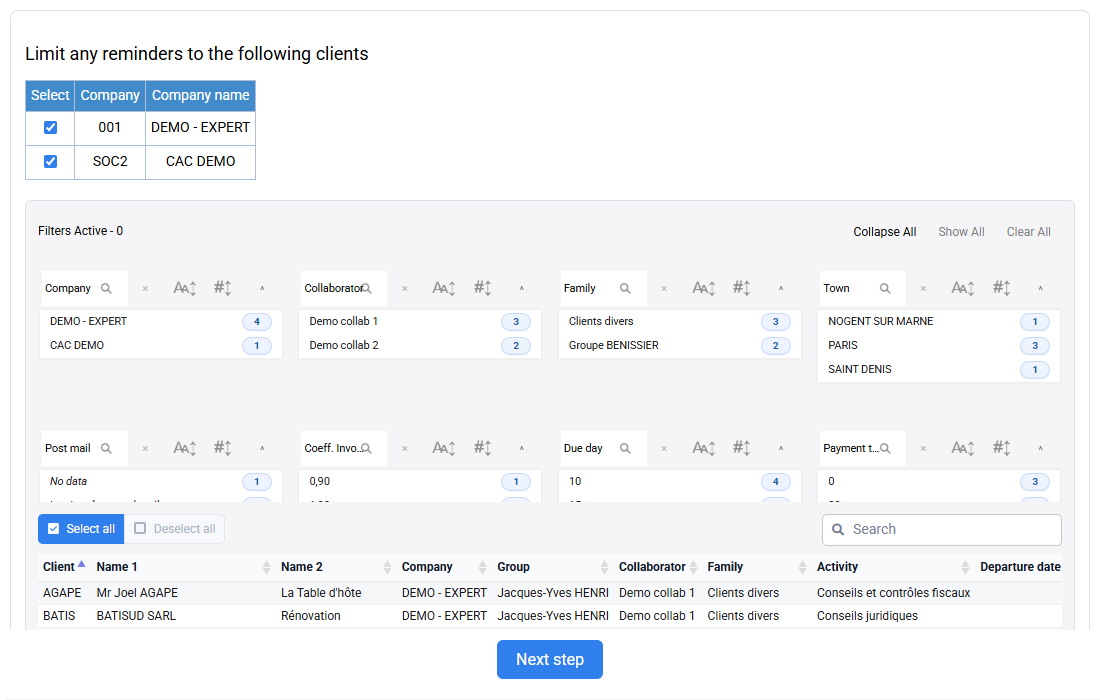
Only in the authorised database containing the prepared case, run the reminder selection for ALPHA CONSEIL only after matching. Explain every included and excluded piece. In the approved clearing branch, F2026-041 is absent and F2026-055 remains for EUR 600.00. If F2026-041 still has a legitimate EUR 15.00 balance, the reminder must reflect that reality instead of the pedagogical target. Check payments received after the reporting cut-off, disputes, credit notes and rejected direct debits before any external communication.
Finally compare the customer movements with the sales and payment exports. If cash-basis VAT is configured, verify that the payment and its matching feed the appropriate fiscal control. Customer follow-up and accounting export answer different questions, but their references, company, amounts and dates must agree.
Guided practice and expected result
Keep the ALPHA calculation sheet separate from the values of your selected customer. Execute matching and reminder preparation only if an authorised database actually contains the ALPHA records; otherwise document the expected controls without creating them.
- 1. On the ALPHA worksheet, record the EUR 615.00 opening difference; in Tempolia, filter the three source screens to the selected company, customer and common period.
- 2. Verify VIR-041, match it to F2026-041 and document why EUR 15.00 remains.
- 3. Apply only the approved accounting branch, recheck matching, then prepare the reminder and SEPA review without sending either.
At the end, check these points
- F2026-041 clears only if the supported EUR -15.00 movement is part of the approved treatment.
- F2026-055 stays open for EUR 600.00 and is the only piece in the reminder under that branch.
- The payment, movements, matching and reminder all tell the same story with traceable references.
Diagnosis if the result differs
- If the remainder is EUR 2,385.00, inspect signs and movement types before changing data.
- If matching is unavailable, verify that selected lines belong to the same customer and company and are in a matchable state.
- If the final balance is not EUR 600.00, remove hidden filters and search for another invoice, credit note, rejection or unmatched payment.
- If F2026-041 remains in the reminder, first determine whether EUR 15.00 is genuinely due; correct matching only when the accounting decision supports clearing.

Common mistakes
- Entering a payment against a similar customer or the wrong beneficiary company.
- Matching first and investigating the difference afterwards.
- Sending a reminder while a recent payment or rejection is still unmatched.
- Treating an expected SEPA collection, generated file and bank settlement as the same event.
- Changing an issued invoice or exported line instead of correcting the authorised source.
Before you finish
Without opening Tempolia, explain how EUR 1,800.00 invoiced, EUR 1,185.00 paid and the documented EUR 15.00 decision lead to the displayed open balance. Then show the payment reference, matching group, residual piece and reminder population. A colleague must be able to reproduce your calculation and identify the point at which human accounting approval was required.
Apply the method to your selected customer
For the on-screen walkthrough, use the customer, optional matter and issued invoice selected in your subscription. Record the actual open balance, payment rows and due-date information visible; do not copy the EUR 1,800.00, EUR 1,185.00 or EUR 15.00 teaching values into this evidence. If a rejection is visible, connect it to its original SEPA mandate or debit and describe its impact on the customer balance.
If the customer-movement view contains no rows, record database, company, customer, period and filters and conclude that matching cannot be proved for the selected scope. A blank table is not a cleared account. Do not create a miscellaneous movement, reminder or bank file merely to obtain the expected result. The deliverable is a diagnosis of the selected account and, for every action you cannot perform, a precise authorised follow-up plan. The ALPHA worksheet remains a separate accounting exercise.
Step back
A reliable balance is not one whose total merely looks plausible. It is one in which each movement has an origin, an approved meaning and a verifiable relationship to a piece. Automate searches for duplicate references, missing banks and unmatched amounts; keep classification of differences, miscellaneous movements and customer communication under human control. The lasting management indicator is not only total receivables, but also the number and value of payments that remain unmatched or unexplained.